
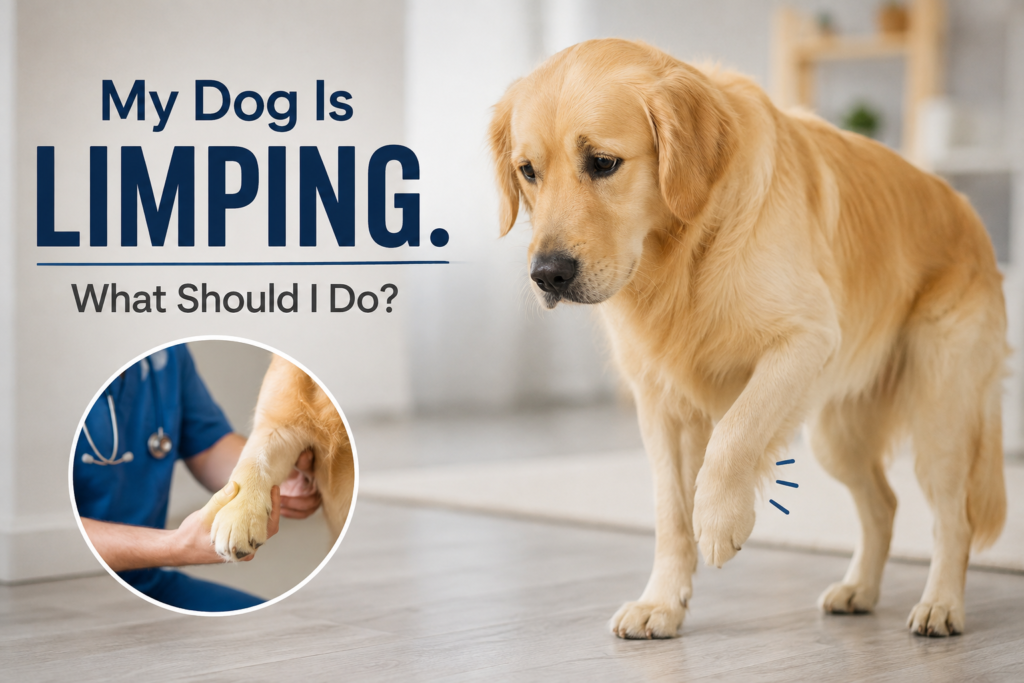
Seeing your dog suddenly limp can be worrying, especially when you are not sure what caused it. Sometimes, a dog may limp because of something relatively minor, such as a small object stuck between the toes or a mild strain after exercise. In other cases, limping can be a sign of an injury, joint problem, infection, or another condition that needs veterinary attention.
If your dog is limping, the first thing to remember is not to assume the cause based only on how the limp looks. Dogs can develop pain in their paws, muscles, bones, joints, or other parts of the leg, and some injuries may not be visible from the outside.
Understanding what to look for can help you decide whether your dog needs rest and monitoring or should be examined by a veterinarian.
What Does It Mean When a Dog Is Limping?
Limping is generally a sign that a dog is experiencing discomfort or has difficulty putting normal weight on one or more legs.
A dog may limp continuously, or the limp may appear only after exercise or when getting up after resting. Some dogs may avoid putting any weight on the affected leg, while others may continue walking but with an unusual gait.
The location and severity of the pain are not always obvious. For example, a dog with a painful hip or knee may appear to have a problem with the entire hind leg. Similarly, discomfort in a paw can cause a dog to change the way they walk and put additional stress on other legs.
Because of this, a proper veterinary examination may be necessary to determine the underlying cause.
Common Reasons Why Dogs Limp
There are many potential causes of limping in dogs. Some are related to minor injuries, while others may involve bones, joints, muscles, ligaments, or other tissues.
Paw or Nail Problems
Sometimes the cause of a limp is located at the very bottom of the leg.
Dogs can step on sharp objects, develop small cuts or punctures, or get something stuck between their toes. A broken, cracked, or damaged nail can also be painful enough to make a dog limp.
If your dog allows you to handle the paw safely, you can gently look between the toes and examine the paw pads for obvious problems. Check for swelling, cuts, bleeding, foreign objects, or a damaged nail.
Do not force your dog to allow an examination if they are frightened or appear to be in significant pain. A painful dog may bite even if they are normally gentle.
Muscle Strain or Minor Injury
Dogs can strain muscles just as people can. Running, jumping, sudden changes in direction, rough play, or intense exercise can sometimes lead to soreness or a minor soft-tissue injury.
A dog with a mild strain may limp after activity but become more comfortable with rest. However, it can be difficult to tell a simple strain from a more significant injury without an examination.
If the limp does not improve or becomes worse, veterinary evaluation is recommended.
Sprains and Ligament Injuries
Ligaments help stabilize joints, and injuries to these structures can cause significant limping.
One of the better-known examples is an injury involving the cranial cruciate ligament, a structure that helps stabilize the knee. Dogs with cruciate ligament problems may suddenly become lame on a hind leg, have difficulty getting up, or be reluctant to run and jump.
Some ligament injuries can worsen if a dog continues normal activity, so persistent or significant limping should not be ignored.
Arthritis and Joint Problems
Arthritis can cause stiffness and discomfort, particularly in older dogs.
A dog with arthritis may not always have a dramatic limp. Instead, you may notice that they are slower to get up, reluctant to climb stairs, hesitant to jump onto furniture, or less interested in long walks.
Some dogs are stiffer after resting and gradually move more comfortably once they have been walking for a while.
Joint problems can also occur in younger dogs, particularly in dogs with certain developmental or orthopedic conditions.
Bone Injuries and Fractures
A fracture can cause sudden and obvious limping, although not every fracture is immediately visible.
Dogs with significant bone injuries may refuse to put weight on a leg, show swelling, or react when the affected area is touched. Some fractures can occur following an obvious accident, while others may happen from less dramatic events depending on the dog’s age and underlying health.
If you suspect your dog has a broken bone, avoid unnecessary movement and seek veterinary care promptly.
Hip or Elbow Problems
Some dogs develop orthopedic conditions affecting the hips or elbows. These problems may cause lameness, stiffness, difficulty exercising, or changes in the way a dog moves.
Hip and elbow conditions can be influenced by genetics, growth, body weight, and other factors. Some dogs show signs when they are young, while others develop noticeable symptoms later in life.
A veterinarian may recommend an orthopedic examination and, when appropriate, imaging to better understand what is happening inside the joint.
Infections or Inflammation
Infections can also cause pain and limping.
A wound, bite, puncture, or other injury may become infected and lead to swelling, warmth, redness, or discharge. In some cases, inflammation deeper within a joint or surrounding tissues can cause lameness without an obvious wound on the skin.
If your dog’s leg appears swollen or unusually warm, or if your dog has a fever, reduced appetite, or seems generally unwell, contact your veterinarian.
Why Is My Dog Limping But Not Crying?
Dogs do not always vocalize when they are in pain.
Some dogs may cry, whine, or react when a painful area is touched. Others may quietly change their behavior instead. A dog may continue eating and interacting with the family while avoiding stairs, running, jumping, or putting full weight on a leg.
This means that the absence of crying does not mean your dog is not in pain.
Changes in movement are often one of the clearest signs that something is bothering a dog.
If your dog suddenly begins limping, pay attention to other changes in their normal activities and behavior.
What Should I Do If My Dog Starts Limping?
The appropriate response depends on how severe the limp is and whether there are other symptoms.
If your dog has a mild limp but is otherwise comfortable, you can start by restricting activity. Avoid running, jumping, rough play, and long walks while you monitor the situation.
You can also carefully check the paw if your dog allows it. Look for an obvious foreign object, damaged nail, cut, or other visible problem.
However, avoid repeatedly manipulating the leg or trying to “test” the joint. If there is an injury, excessive handling could cause additional pain or potentially worsen the problem.
If the limp continues, becomes more noticeable, or your dog seems uncomfortable, schedule a veterinary examination.
Should I Let My Limping Dog Walk?
A dog with a mild limp may be able to take short, controlled walks for bathroom needs, but it is generally better to avoid strenuous activity until the cause of the limp is understood.
Running, jumping, chasing toys, climbing stairs, and rough play can place additional stress on an injured leg.
If your dog refuses to walk or cannot put weight on the leg, do not force them to move around. Contact a veterinarian for guidance.
When Should I Take My Dog to the Vet for Limping?
Some cases of limping can be monitored briefly, but others require veterinary attention.
You should contact a veterinarian if your dog’s limp:
- Does not improve with rest
- Gets progressively worse
- Keeps returning after activity
- Is accompanied by swelling
- Is accompanied by obvious pain
- Prevents your dog from using the leg normally
- Occurs alongside changes in appetite or behavior
- Develops without an obvious explanation
A persistent limp should not simply be considered a normal part of aging.
When Is Dog Limping an Emergency?
A sudden severe limp can require urgent veterinary attention, particularly if your dog cannot stand or walk normally.
Seek prompt veterinary care if your dog has severe pain, cannot bear weight on a leg, has a visibly abnormal or deformed limb, has significant swelling or bleeding, or has been involved in a serious accident.
Limping accompanied by difficulty breathing, collapse, extreme weakness, or other severe symptoms should also be treated as an emergency.
When an injury appears serious, minimize movement and seek professional veterinary care rather than trying to treat the problem yourself.
Can I Give My Dog Pain Medication?
Do not give your dog human pain medication unless a veterinarian specifically tells you to do so.
Medications that are safe for people can be dangerous or even toxic to dogs. The appropriate medication and dose depend on the dog’s size, age, health, other medications, and the underlying cause of pain.
If your dog appears painful, contact your veterinarian rather than using medication from your own medicine cabinet.
How Do Veterinarians Find the Cause of a Limp?
A veterinarian will usually begin by taking a history and performing a physical examination.
They may ask when the limp started, whether it appeared suddenly or gradually, whether there was an injury, and whether your dog’s activity level has recently changed.
During the examination, the veterinarian may observe your dog’s gait and carefully assess the limbs, joints, muscles, paws, and other areas that could be contributing to the problem.
Depending on the findings, diagnostic tests such as X-rays or other imaging may be recommended. In some cases, additional testing may be necessary to identify soft-tissue injuries or other underlying conditions.
The goal is not simply to determine which leg hurts. It is to identify why the dog is limping so that an appropriate treatment plan can be developed.
What Happens If My Dog Has a Minor Injury?
Treatment depends entirely on the underlying cause.
For a mild soft-tissue injury, a veterinarian may recommend rest and restricted activity while the affected area heals. Other conditions may require medication, rehabilitation, weight management, supportive care, or more advanced treatment.
Orthopedic injuries, fractures, or significant ligament problems may require a different approach.
This is why it is not a good idea to assume every limp is a simple sprain. The appropriate treatment depends on what is actually causing the pain.
How Can I Help Prevent Injuries?
You cannot prevent every cause of limping, but several everyday habits can support your dog’s musculoskeletal health.
Maintaining a healthy body weight is particularly important because excess weight places additional stress on joints and can make mobility problems more difficult.
Regular, age-appropriate exercise can also help maintain muscle strength and mobility. However, exercise should be increased gradually rather than suddenly asking an inactive dog to perform strenuous activity.
Keeping your dog’s nails at an appropriate length can also help support normal movement, while regular veterinary checkups can help identify developing orthopedic or health problems before they become more serious.
Frequently Asked Questions
Why is my dog limping all of a sudden?
Sudden limping can result from a paw injury, damaged nail, muscle strain, ligament injury, joint problem, or another painful condition. If the limp is severe, your dog cannot bear weight, or there are other concerning symptoms, seek veterinary care promptly.
Should I be worried if my dog is limping but still eating?
A normal appetite is a positive sign, but it does not rule out an injury or painful condition. If the limp persists, worsens, or affects your dog’s normal activity, a veterinary examination is recommended.
How long can a dog limp before going to the vet?
There is no universal timeframe because the appropriate response depends on the severity and cause. A mild limp may improve with rest, but persistent or worsening limping should be evaluated. Severe pain or an inability to use the leg warrants prompt veterinary attention.
Can a dog limp from sleeping awkwardly?
A dog may occasionally move stiffly after resting, particularly if they are older. However, persistent limping should not automatically be attributed to sleeping position. If the abnormal movement continues, your dog should be examined.
Should I massage my dog’s leg if they are limping?
It is better not to massage or manipulate a painful leg unless your veterinarian has recommended it. Some injuries can become more painful or potentially worsen with unnecessary manipulation.
Can overweight dogs be more likely to develop joint problems?
Excess body weight places additional stress on joints and can contribute to mobility problems. Maintaining an appropriate body condition is an important part of supporting long-term joint health.
What if my dog stops putting weight on the leg?
A dog that suddenly refuses to bear weight on a leg may have a significant injury or another painful condition. Contact your veterinarian promptly, particularly if there is swelling, severe pain, or a recent accident.
Final Thoughts
A limping dog should not automatically cause panic, but it should not be ignored either.
A minor paw problem or temporary muscle strain may resolve with appropriate rest, while persistent limping can be associated with joint disease, ligament injuries, fractures, infections, or other conditions that require veterinary treatment.
Pay attention to how suddenly the limp appeared, whether your dog can put weight on the leg, whether there is visible swelling or injury, and whether your dog has other changes in appetite, behavior, or activity.
Most importantly, do not give human pain medication or force your dog to exercise when they are limping.
If you are concerned about your dog’s movement or the limp is not improving, a veterinary examination can help identify the cause and determine the safest next step.
Veterinary Care for a Limping Dog in Mississauga
If your dog is limping and you are unsure whether they need an examination, Erin Centre Animal Hospital can help assess your dog’s condition and determine what may be causing the change in movement.
A veterinary assessment can be especially important when limping is persistent, worsening, associated with pain, or accompanied by other changes in your dog’s health.
For veterinary care and professional advice, contact Erin Centre Animal Hospital to discuss your dog’s symptoms and arrange an appointment.
Veterinary Disclaimer
This article is intended for general educational purposes and does not replace professional veterinary examination, diagnosis, or treatment. If your dog is experiencing severe pain, cannot walk normally, has suffered a significant injury, or develops other concerning symptoms, seek veterinary care promptly.